Applications / non-contact heat treatment depth measurement
01 — Introduction
Surface heat treatment: a key step for high-performance metal parts
Surface heat treatment is one of the most widely used techniques in modern industry to engineer the contact layer of a metal part — drastically increasing its surface hardness, wear resistance and fatigue life while preserving the toughness of the bulk material underneath. For demanding applications in food and beverage equipment, medical devices, oil & gas valves, automotive components and aerospace parts, surface treatment is the only way to deliver a hard, wear-resistant skin on parts that must, simultaneously, resist corrosion, remain dimensionally stable and keep their surface aesthetic.
Several heat-treatment families are used industrially, each generating its own diffusion-zone signature and each requiring tight depth control:
Low-temperature surface hardening (S³P / Kolsterising-type) Carburizing Nitriding & nitrocarburizing Induction hardening
Low-temperature surface hardening processes — known under trade names such as Kolsterising or S³P — are particularly powerful on austenitic stainless steels: they create a sub-surface layer of expanded austenite (also called S-phase) that contains supersaturated nitrogen on roughly the upper third of the depth and supersaturated carbon on the lower two thirds. The result is a surface hardness that can reach up to 1400 HV 0.05, with no measurable loss of corrosion resistance and no change in the visual appearance of the part. Carburizing and nitriding are widely used on low-alloy steels to produce hardened cases that can extend several hundreds of microns deep. Induction hardening creates a localized martensitic layer on selected zones of carbon and tool steels.
In every one of these processes, the depth of the treated layer — diffusion depth, expanded-austenite depth, or hardened case depth — is the critical metallurgical output. Too shallow a layer compromises wear and fatigue performance; too deep a layer can affect dimensions, distort the part, or weaken the substrate. Controlling this depth, batch after batch and part after part, is therefore the central quality challenge of every surface-hardening line.
Figure 1 — Surface heat-treatment production sequence
02 — Quality Requirements
Why treatment depth is the critical quality parameter
Once the heat-treatment cycle is complete, the depth of the diffusion or hardened layer becomes the single most important quality indicator of the entire process chain. It is the parameter that determines whether the part will deliver its specified wear, fatigue and corrosion behaviour in service — and several independent factors converge to make its measurement essential.
Functional performance: the depth defines the part's life
The hardened or diffusion zone is what carries the contact load, resists abrasion and absorbs cyclic stresses. An under-treated part fails prematurely in service through wear, galling or fatigue cracking. Conversely, an over-treated part can suffer dimensional drift, embrittlement or — in the case of stainless steels — locally degraded corrosion resistance if the diffusion process is pushed beyond its metallurgical window. The treatment depth must therefore stay inside a tightly defined band: typically a few microns wide for low-temperature processes such as S³P, and a few tens of microns for traditional carburizing and nitriding.
Batch-to-batch and part-to-part uniformity
Surface heat treatment is a furnace-based, multi-parameter process. Gas composition, temperature uniformity inside the load, dwell time, position of each part inside the furnace and the cooling profile all influence the final depth. Ensuring that every part of every batch meets specification — not just an average value — is what separates a qualified production line from one that generates returns and recalls. International standards and ISO 9001 quality systems require demonstrable evidence of conformity for every batch.
Process drift monitoring
Over time, several process parameters can drift and collectively affect treatment depth: thermocouple ageing, gas-flow regulator wear, atmosphere composition, furnace contamination, chamber leaks, fixture loading repeatability. Measuring 100% of production — rather than a destructive sample once per batch — is the only reliable way to detect such drifts before they generate large populations of non-conforming parts.
|
< 1 µm
Repeatability achieved on diffusion-depth measurements (depending on the optical system selected and the layer depth)
|
1 second
Typical measurement time per point — fully compatible with in-line operation
|
|
300 µm
Minimum laser spot diameter — sub-millimetric resolution for small or geometrically complex parts
|
100 %
Inspection coverage — every batch, every part, in-line or at-line
|
03 — Measurement Challenges
Why conventional methods fall short on surface-hardened parts
Heat-treatment depth has historically been one of the hardest physical parameters to control in production. The combination of small depths (a few microns to a few hundred), demanding accuracy, and the wide variety of part geometries leaving a furnace pushes conventional methods to their limits — and on austenitic stainless steels, several of those methods simply do not work at all.
Cross-section + microhardness profile: the destructive reference
The metallographic cross-section followed by a Vickers microhardness profile is the reference method for treatment-depth qualification, and the only one accepted in most quality protocols at the qualification stage. It is accurate and fully traceable, but also destructive: the part is cut, mounted, polished and indented under a microscope. The full procedure typically takes several hours of laboratory operator time per part, which is why production plants have to limit themselves to one or two control samples per batch — meaning that any drift of the furnace can go undetected for an entire batch before being visible in the quality data.
Vickers surface hardness: an indirect and surface-altering check
Surface microhardness measurement (Vickers HV 0.05 or similar) is sometimes used as a faster, semi-quantitative check on treated parts. It is much quicker than a full cross-section but it has two structural drawbacks. First, it is an indirect measurement — it captures the hardness of the very top surface, not the depth of the diffusion layer underneath, and these two parameters do not always correlate one-to-one. Second, the indentation physically alters the surface morphology in the area of measurement, which is unwanted on parts where surface aesthetics, roughness or sealing function matters. Used as a 100% inspection method, Vickers testing also requires considerable operator time.
Eddy current and magnetic methods: not applicable to austenitic stainless steels
Eddy-current and magnetic-induction probes are widely used for non-destructive depth measurement on ferromagnetic substrates such as low-alloy carburized or nitrided steels. On austenitic stainless steels, however, the substrate is non-magnetic and these methods cannot be applied successfully to characterize the diffusion layer left by low-temperature surface hardening — a limitation that has been formally documented in the technical literature and confirmed by industrial users of S³P-type processes. Acoustic methods, for their part, are highly geometry-dependent and not generally implementable on the variety of part shapes that leave a typical heat-treatment line.
As reported in the joint Enovasense–Bodycote evaluation published in heat processing magazine (issue 2-2018), photothermal radiometry was successfully applied for the first time to non-destructively classify low-temperature surface-hardened austenitic stainless steel parts — an application where eddy-current and acoustic methods had previously failed.
The case for non-contact, non-destructive, 100% inspection
Measuring non-destructively, without contact and on every part transforms the quality paradigm of a heat-treatment line:
- The part is preserved — measured parts can ship to the customer; no scrap is generated by the inspection itself.
- Closed-loop feedback on the furnace becomes possible: drift is flagged after a handful of parts rather than entire batches.
- Full coverage — every batch, every part, with a measurement cycle short enough to keep up with production flow.
- Zero operator time on routine measurement when the system is integrated into an automated control station.
Video — Customer testimony: Thermi-Lyon, heat-treatment specialist
Thermi-Lyon, a leading European specialist in surface heat-treatment, shares its experience deploying Enovasense laser photothermal radiometry to non-destructively control the depth of low-temperature surface-hardened stainless steel parts.
04 — Technology Comparison
Why laser photothermal radiometry is the ideal solution
Enovasense's laser photothermal radiometry resolves all of the limitations described above in a single sensor. A modulated laser beam slightly heats the surface of the part; the heat propagates into the diffusion layer and back to the surface; an infrared detector captures the temporal profile of that returning thermal flux; and the depth of the treated layer is extracted from the characteristic phase shift of the thermal response. The method is fully non-contact, non-destructive, applies to a wide variety of substrates including non-magnetic austenitic stainless steels, and delivers a result in the order of one second per measurement point.
| Criteria | Enovasense laser photothermal | Eddy current / magnetic probe | Cross-section + microhardness (destructive) |
|---|---|---|---|
| Non-contact measurement | Yes | No — probe contact required | No — part is destroyed |
| Non-destructive | Yes | Yes | No |
| Applicable to austenitic stainless steels | Yes | No — non-magnetic substrate | Yes |
| In-line / at-line automation | Yes — compact head, < 200 g | Limited — geometry dependent | No |
| 100% inspection coverage | Achievable | Sampling — when applicable | ≈ 1 in N parts per batch |
| Repeatability (standard deviation) | ±0.5 µm | Not applicable on austenitic SS | Reference method |
| Correlation with destructive reference (R²) | ≈ 97.6 % | Not applicable on austenitic SS | Reference method |
| Measurement time per point | ≈ 1 s | Few seconds per point | Several hours per part |
| Closed-loop process feedback | Yes — real-time data to MES | Limited | No |
Repeatability and R² values from a representative Enovasense calibration study on austenitic stainless steels surface-hardened with a low-temperature S³P-type process (see section 05). Performance depends on the optical system selected and on the layer depth.
05 — Metrological Performance
Calibration study on surface-hardened stainless steels
The performance of Enovasense laser photothermal radiometry on the diffusion-depth measurement of low-temperature surface-hardened stainless steels has been validated through a representative calibration study performed on samples of two commonly used austenitic grades (1.4571 and 1.4404) treated to nominal depths covering the typical industrial operating range. For each treatment level, ten measurements were taken at distinct positions on the sample to capture both the sensor response and the natural part-to-part variability of the treated layer; lab-reference depths were obtained by destructive cross-section microscopy.
The repeatability and accuracy figures reported below correspond to the configuration used during this calibration study. Actual performance on a given application depends on the optical system selected (focal length, numerical aperture, laser parameters) and on the depth range to be measured.
A single calibration covers a family of austenitic stainless steels
One particularly useful outcome of the study is that a single calibration curve was sufficient to cover both stainless steel grades tested, despite their different chemical compositions. This means that, on a typical heat-treatment line handling a family of austenitic stainless steel parts, the user does not need to maintain a different calibration per material reference — a major operational simplification compared to methods that are exquisitely sensitive to substrate composition.
Accuracy: regression vs the destructive reference
For the photothermal sensor, the average raw signal at each treatment level is plotted against the true depth obtained by destructive cross-section microscopy. The black line is the linear regression model used to convert the raw signal into a depth value. The coefficient of determination R² quantifies how closely the measurements follow the regression model — a value of 1.00 would indicate perfect agreement.
Figure 2 — Calibration regression: lab-reference depth vs Enovasense measurement
Calibration regression on austenitic stainless steel samples surface-hardened with a low-temperature S³P-type process. Six treatment levels were tested with ten measurements each. Lab reference: destructive cross-section microscopy.
The Enovasense sensor reaches a coefficient of determination of R² ≈ 97.6 % against the destructive reference, with a mean absolute deviation of approximately 1.4 µm over the full operating range — fully sufficient to discriminate the depth windows targeted by industrial heat-treatment specifications.
Repeatability: detecting fine drifts of the furnace
The second key metric is repeatability — the dispersion of ten successive measurements taken at exactly the same point of a treated sample, expressed as a standard deviation. This is the metric that determines whether small process drifts can actually be resolved by the measurement system: the lower the standard deviation, the finer the drift that can be reliably detected.
Figure 3 — Repeatability of Enovasense on a treated stainless steel sample (10 measurements, same point)
All ten measurements fall well inside the typical ±2 µm process tolerance band (green) and within the ±1σ envelope of the sensor (red). A standard deviation of ±0.5 µm on a 17.8 µm mean depth corresponds to roughly ±3% reproducibility — fine enough to detect furnace drifts that would otherwise stay buried inside the noise of conventional approaches.
With a standard deviation of ±0.5 µm, the Enovasense sensor delivers the level of repeatability required for closed-loop process control on low-temperature surface-hardening lines. Combined with the high R² obtained against the destructive reference, this margin is what enables the detection of furnace drift, fixture issues and atmosphere variation before they generate large populations of non-conforming parts.
06 — Industrial Integration
The HAKO platform: at-line and in-line control stations
For 100% non-destructive control of treatment depth on heat-treated parts, Enovasense offers the HAKO range — a family of self-contained measurement stations covering everything from compact HAKO-M benches for laboratory and QA use, through the medium-format HAKO-L for at-line production control, up to the large-format HAKO-XL for in-line monitoring of bulky parts such as engine blocks. Each HAKO station handles automatic loading, multi-point measurement, calibration management and data export, with no operator interaction required during the measurement cycle.
Three formats for three deployment scales
| Specification | HAKO-M | HAKO-L | HAKO-XL |
|---|---|---|---|
| Typical use | Lab / R&D / QA bench — small parts | At-line / production — medium parts | In-line / large parts (e.g. engine blocks) |
| Automation | 3-axis Cartesian | 3-axis Cartesian | 5 axes |
| Maximum part size (m) | 0.30 × 0.30 × 0.25 | 0.55 × 0.50 × 0.40 | 0.65 × 0.60 × 0.40 |
| Axis travel (m) | 0.35 × 0.30 × 0.20 | 0.45 × 0.45 × 0.30 | 0.80 × 0.60 × 0.40 |
| Station footprint (m) | 0.60 × 0.60 × 0.71 | 1.20 × 0.90 × 0.85 | 2.20 × 2.60 × 1.25 |
| Station weight | 80 kg | ≈ 350 kg | ≈ 1500 kg |
| Laser class | Class 1 | Class 1 | Class 1 |
The Enovasense measuring head
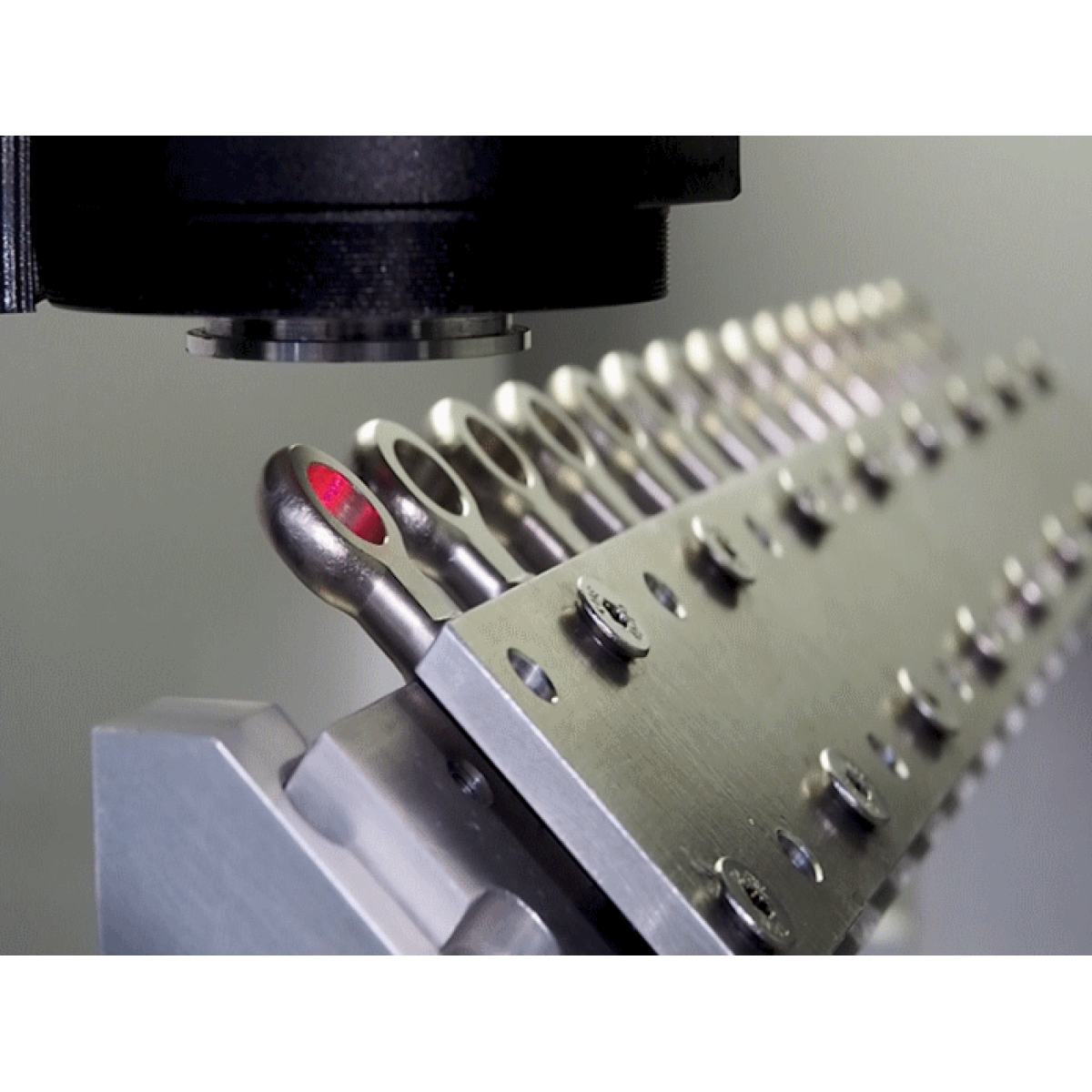
At the heart of every HAKO station is the same compact measuring head — less than 200 g, plug-and-play — connected to a controller housing the laser source, the IR detection electronics, and the signal-processing unit. The standard configuration uses a 980 nm laser (typically up to 10 W of optical power, modulated), with a working distance of approximately 40 mm and a laser spot diameter that can be adapted from 300 µm (sub-millimetric resolution for small parts) up to 10 mm (high SNR on larger pieces). Long-distance optics extending the working distance to 450 mm are available for parts that are difficult to approach. A typical measurement takes 1 second per point.
System architecture
Figure 4 — HAKO system architecture
Technical specifications — Enovasense measuring system
| Measurement principle | Laser photothermal radiometry (patented) |
| Laser wavelength / power | 980 nm, up to 10 W optical (configurable) |
| Typical measurement depth range | From sub-µm coatings to ≈ 1 mm thick layers (depends on application) |
| Measurement time per point | ≈ 0.1 s to 2 s |
| Working distance (head ↔ part) | 40 mm ± 1 to 10 mm (standard) — 450 mm ± 100 mm (long-distance optics) |
| Laser spot diameter | Configurable: Ø 0.3 / 0.6 / 2 / 10 mm |
| Repeatability | < 1 µm (depends on the optical configuration and the layer depth) |
| Measuring head dimensions / weight | 93 × 66 × 66 mm (cylindrical Ø66 × 93 mm), 400g |
| Controller dimensions / weight | 123 × 200 × 85 mm, 1.7 kg |
| Cable length (head ↔ controller) | 1 to 20 m (configurable) |
| Data interface | TCP/IP — Ethernet/IP — CSV export — MES / SPC integration |
| Set-point input | TTL 0–5 V |
| Power supply | 100–240 Vac, 50–60 Hz, 4.5–2.5 A |
| Operating temperature | 0 °C to +50 °C ambient |
| Part temperature tolerance | 0–40 °C without correction — up to 800 °C with correction |
| Safety | Class 1 laser station, CE-compliant, light curtains, emergency stops |
Specifications are indicative and can be adapted to specific customer requirements.
Deployment steps
Documents
| Type | Name | Download |
|---|---|---|
| Application | Non-destructive classification of surface hardened stainless steels | English |

 Deutsch
 Español
 Français
 Italiano
 日本語
日本語
 한국어
한국어
 Polski
 中文
中文