Products / hk m - 3 axes compact control station
01 — Product Overview
Enovasense HKM Control Station
Compact turnkey laser photothermal coating-thickness measurement bench — for small parts in lab, R&D and QA
The Enovasense HKM is the compact, entry-level control station of the Enovasense family. It integrates the Enovasense Point Sensor inside a laser-safe enclosure, together with an automated 3-axis positioning system, a touchscreen HMI and the full Enovasense Suite software. It turns a raw photothermal sensor into a complete non-contact, non-destructive coating-thickness measurement solution — ready to receive a small part, position it automatically under the probe, run a programmed cycle and return thickness values and 2D thickness maps in real time.
The HKM is designed for laboratory, R&D and quality-assurance benches dedicated to the control of small parts — flat, stepped or simple 3D geometries up to 0.3 × 0.3 × 0.25 m. It measures paint, polymers, adhesives, anodizing, electroplating, thermal spray, cold spray, HVOF, PVD, CVD, PACVD, galvanizing, and screen-printing deposits on virtually any substrate — covering thicknesses from 100 nm up to 1 mm on a single platform.
Class 1 laser enclosure Automated 3-axis Compact footprint Touchscreen HMI Thickness mapping Lab & QA
|
0.1μm-1mm
Measurable thickness range on a single platform
one station for thin and thick coatings
|
<3%
Typical accuracy of the measured thickness
depends on the optical system selected and the coating
|
|
600×600×710mm
Compact footprint — fits on any standard bench
only 80 kg total weight
|
Class 1
Overall laser classification of the station (IEC 60825-1)
safe under all conditions of normal use
|
02 — Why choose the HKM control station
Six reasons this station earns its place on a lab or QA bench
1. A Class 1 laser enclosure — safe for every operator
A Class 4 laser source is installed inside the HKM, but the station as a whole is certified Class 1 according to IEC 60825-1, meaning it is safe under all conditions of normal use. A large laser-filter window on the front loading door lets the operator see the part being measured, while a coded magnetic interlock, a front emergency stop button and PLe-rated safety relays ensure the laser flux and the axes are cut as soon as the door is opened. No laser-safety training or eyewear is required for normal operation.
2. Compact footprint — fits any laboratory bench
At only 0.6 × 0.6 × 0.71 m and 80 kg, the HKM is the most compact control station of the Enovasense range. It fits on any standard laboratory or QA bench without dedicated infrastructure and is powered from a single 100–240 V AC outlet. The complete station — enclosure, axes, sensor, controller, embedded PC and touchscreen — comes ready to use out of the box.
3. Automated positioning — precise, repeatable, cycle-ready
The HKM integrates a 3-axis Cartesian positioning system (X, Y, Z strokes of 350 × 300 × 200 mm) with 20 µm accuracy. The probe is moved automatically from one measurement point to the next according to a programmed cycle, so an operator can load a part, press start, and come back to a finished thickness map.
4. A full software suite — from signal tuning to thickness maps
The HKM ships with the Enovasense Suite — a complete application environment covering signal testing, frequency scanning, calibration training (neural network), single-point measurement, cycle editing and automated cycle execution. Thickness colormaps, curves and statistics are built live as the cycle runs, and all data is exported as CSV for MES or SPC integration.
5. Compatible with the full Enovasense optical-tool range
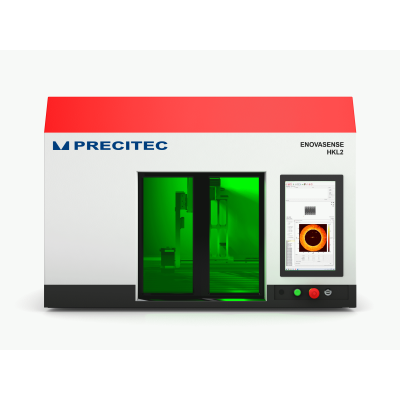
The HKM accepts every optical tool of the Enovasense catalog — simple lenses (vertical measurement) and mirror tools (horizontal measurement on side walls or shoulders) — and laser modules from 1 W to 150 W at wavelengths of 445 nm, 980 nm, 1450 nm and 1550 nm. The same calibration logic and software workflow used on the larger Enovasense stations applies on the HKM, making it the natural lab companion to a production HKL2 or HKXL station.
6. Maintenance-light and consumable-free
The HKM has no fluids, no consumables and no destructive sample preparation. Routine maintenance is limited to monthly cleaning of the front lens and the inside of the enclosure, and a quarterly check of the mechanical fixings. The whole station is built around a single embedded PC and a sealed sensor controller — there is nothing for the user to take apart on a daily basis.
03 — Applications
Where the HKM control station is used
The HKM is the smallest of the Enovasense benchtop control stations. It is deployed across industries wherever small flat or moderately complex parts need reliable, non-destructive coating-thickness control:
| Watchmaking & jewellery | Decorative coatings, PVD on small components, lacquers and varnishes on dials and cases |
| Medical devices | Bioactive coatings on small implants, polymer and PVD coatings on surgical tools |
| Consumer electronics | Decorative coatings on small casings and connectors, conformal coatings on PCBs, thin metallic and polymer stacks |
| Semiconductor & thin films | Thin film layers deposited by PVD, CVD, PACVD, screen printing, sol-gel; dielectric and encapsulation stacks, epoxy layers |
| R&D laboratories | Process characterization, coating development, destructive-method replacement on production samples |
| General industry | Powder coatings, e-coat, adhesives, screen-printing inks, hard-chrome plating, ceramic coatings on small parts |
04 — Technology
Laser photothermal radiometry — integrated in a safe, automated station
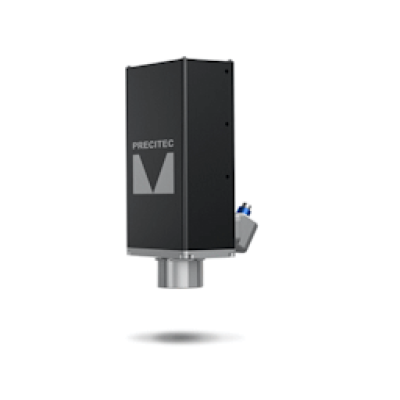
The HKM embeds the Enovasense Point Sensor inside a safe, automated enclosure. A modulated laser beam emitted by the module travels through an optical fiber to the probe, is focused on the coating surface and generates a controlled thermal wave inside the coating. An infrared detector inside the probe captures the returning heat wave. The coating thickness is then derived from these signals through a calibration trained on reference samples.
Why this technology — a summary
Photothermal radiometry is fully optical and thermal: no contact with the part, no electrical or magnetic coupling required. This means the sensor is indifferent to the magnetic properties of the substrate, to surface roughness (within a large range), to part geometry and to the production environment. Inside the HKM, the sensor benefits from a controlled enclosure, an automated positioning system and a dedicated HMI — making every measurement repeatable and operator-independent.
05 — General Description
The HKM station at a glance
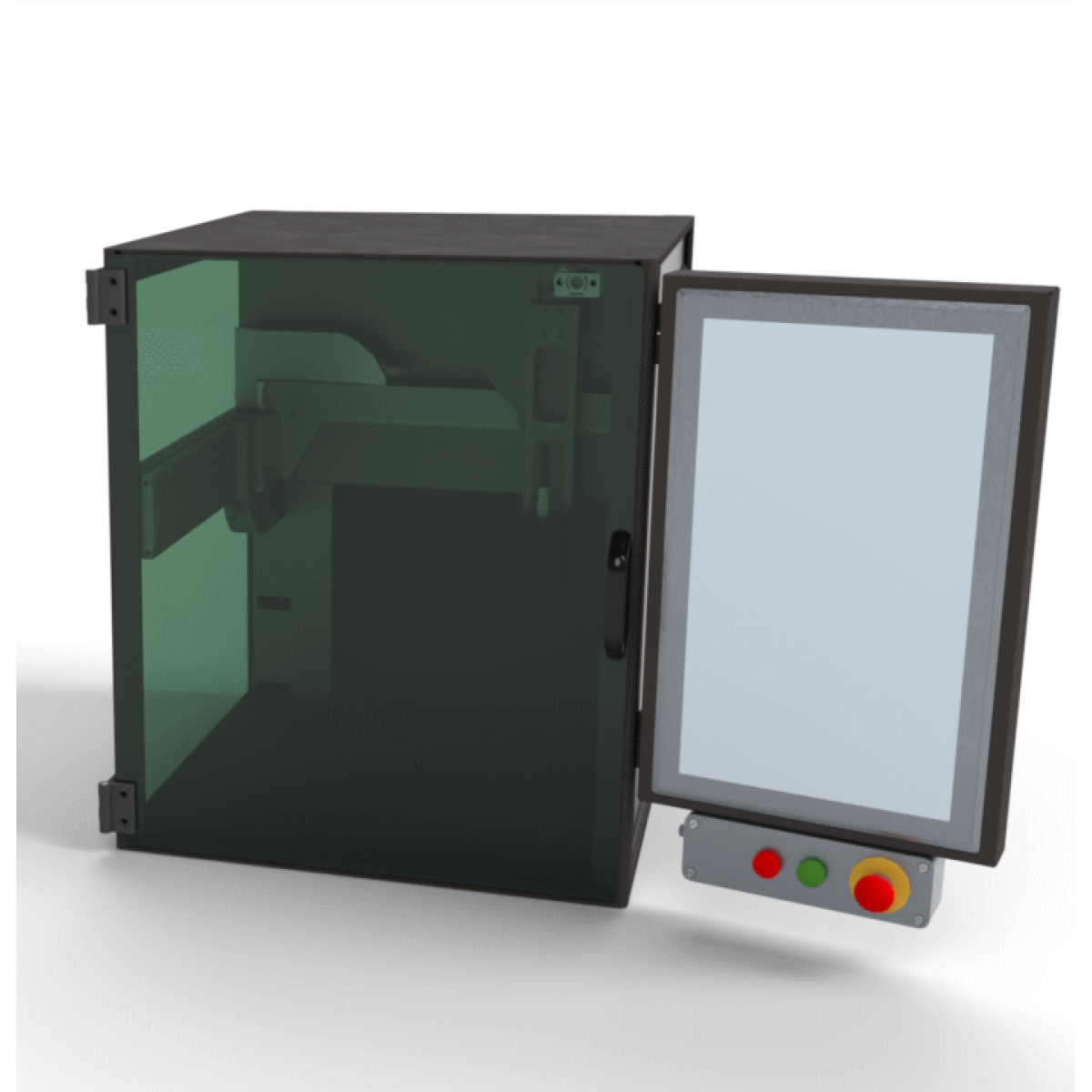
The HKM is built around four main functional blocks: a touchscreen control HMI mounted on a side panel, a laser-safe loading door on the front, an internal probe positioning system with the 3-axis Cartesian robot, and an integrated electrical compartment housing the sensor controller, the laser module and the embedded PC.
Figure 1 — HKM front view and main functional blocks
Control HMI — the operator interface
A 15.6" touchscreen mounted on a dedicated side panel runs the full Enovasense Suite. Directly below it sit a power indicator light, the emergency stop button and USB slots for a mouse, a keyboard or a USB key. Every function of the station can be operated from the touchscreen alone. The loading door is opened manually by its front handle — no door push button is required.
Loading door and measurement area
The single hinged door opens the full front face of the station to load parts inside. The bottom of the measurement area features a flat work surface with a fixturing zone for sample positioning. The large transparent window on the door is normalized laser-safety glass (IEC 60825-1) that blocks the laser flux while allowing the operator to visually monitor the measurement. A door-closure sensor combined with a magnetic interlock guarantees that the laser cannot be emitted when the door is open.
Probe positioning system
Inside the station, a 3-axis Cartesian translation system moves the optical probe above the loaded part. The probe is fixed to the Z axis and can carry any Enovasense optical tool, including simple lenses for vertical measurements and 90° mirror tools for horizontal measurements. The XYZ axes provide 350 × 300 × 200 mm of stroke with a positioning accuracy of 20 µm.
Electrical compartment
An integrated electrical compartment houses the sensor controller (Precitec / Enovasense Point Sensor controller), the laser module, the axes electronics, the embedded PC and the safety relays. The compartment is sealed against unintended access during normal operation; opening it for maintenance is reserved to trained personnel.
06 — Software & Workflow
The Enovasense Suite — from raw signal to thickness map
All functions of the station are accessible through a unified launcher. The typical workflow on a new coating-substrate application goes through four phases, which are then reused without modification for every subsequent production measurement:
Figure 2 — The four phases of the HKM workflow
Recipe editor — programmable, point-by-point
The HKM recipe editor lets the operator define a part grid (geometry, origin, pitch, height of the part), a list of measurement points on a representative part and a calibration per point. Recipes are saved, reloaded and reused for every subsequent batch — load the part, select the recipe, press start.
Live visualization — curves and grid view
As a cycle runs, each measurement is written to a measurement table together with its X, Y, Z coordinates, the calibration used and the thickness value. The HMI offers a live grid view of the part status (waiting / measured OK / warning / error against the recipe tolerances), a per-part summary and detailed measurement results — all updated in real time during the cycle.
Sensor verification — daily metrology check
The HKM software includes a built-in sensor verification mode: a short automated cycle on internal reference samples, run on demand or at a configurable recall frequency, that validates the sensor's stability before a measurement campaign. The history of verifications is logged and can be consulted at any time.
Data storage and export
All measurements are stored on the integrated PC as CSV files. Each line contains the date, time, recipe name, measurement index, X/Y/Z position, calibration used, an operator comment, the raw photothermal signals and the final thickness value. The storage directory and the file-naming rules are configurable, making it straightforward to integrate with MES or SPC systems via a shared folder on the local network (RJ-45 Ethernet).
07 — Technical Specifications
Full technical datasheet — HKM control station
Key measurement parameters
| Measurable thickness range | 0.1 – 1000 µm |
| Accuracy | < 3 % of the measured thickness |
| Measurement duration (1 point) | 10 – 1000 ms |
| Measuring rate | 1 – 100 Hz |
| Available laser wavelengths | 445 nm, 980 nm, 1450 nm, 1550 nm |
| Maximum laser optical power | 150 W (module reference dependent) |
| Overall machine laser class | Class 1 (IEC 60825-1) |
Typical repeatability
| Thickness range |
RMS repeatability (1 point) |
Treatment or coating process |
|---|---|---|
| 0.01 – 0.1 µm | ±0.01 µm | PVD, CVD, PACVD, electroplating |
| 0.1 – 1 µm | ±0.05 µm | PVD, CVD, PACVD, electroplating, screen printing |
| 1 – 5 µm | ±0.1 µm | PVD, CVD, PACVD, electroplating, anodizing, spray, screen printing |
| 5 – 50 µm | ±0.5 µm | Anodizing, electroplating, galvanizing, spray, screen printing |
| 50 – 300 µm | ±1 µm | Thermal spray, cold spray, galvanizing, spray |
| 300 – 1000 µm | ±3 µm | Thermal spray, cold spray |
Mechanical & loading characteristics
| Station dimensions, door closed (L × W × H) | 0.6 m × 0.6 m × 0.71 m |
| Station footprint, door fully open | ≈ 0.98 m × 0.6 m |
| Station weight | 80 kg |
| Maximum part size (X × Y × Z) | 0.3 m × 0.3 m × 0.25 m |
| Maximum part weight | 10 kg |
| Axes automation | 3-axis Cartesian |
| Axes stroke (X × Y × Z) | 0.35 m × 0.30 m × 0.20 m |
| Axes accuracy | 20 µm |
| Sample fixturing | Flat work surface with customizable fixturing zone |
| Control HMI screen size | 15.6 in touchscreen |
| Sound pressure level (LpAd) | < 70 dB(A) |
Electrical & environmental specifications
| Incoming voltage | 100 – 240 V AC |
| Incoming voltage frequency | 50 – 60 Hz |
| Power consumption | 1 kW |
| Data interface | RJ-45 Ethernet — CSV export — MES / SPC compatible |
| Operating temperature | −5 to +40 °C |
| Humidity range (operation) | 30 to 75 % |
| Humidity range (storage) | 10 to 90 % |
Safety devices
| Overall laser classification | Class 1 (IEC 60825-1 — safe under all conditions of normal use) |
| Door interlock | Coded magnetic interlock on the loading door |
| Emergency stop | Front-panel e-stop linked to laser & axes interlock |
| Safety logic | Safety relays at the highest safety level (PLe) |
| Laser-safety window | Normalized laser-filter glass on the loading door |
| Compliance | CE, Machine Directive 2006/42/CE, EMC 2014/30/EU, RoHS 2011/65/EU, REACH |
All values are typical. Actual performance depends on the combination of items selected (module power, optical tool, coating family) and on the target application. Please contact Enovasense for a performance diagnosis on your specific samples.
08 — Station Configuration
Available laser modules for the HKM
An HKM control station is always delivered with one integrated Enovasense Point Sensor, configured with one of the laser modules listed below. The choice of wavelength and power depends on the coating material and thickness range to be measured. Switching between different laser sources inside a deployed HKM is only permitted to be done by Precitec Optronik / Enovasense personnel, as it may require changing the laser-safety door.
| Reference | Wavelength | Max power | Typical use |
|---|---|---|---|
| C3-W445P3-T033 | 445 nm | 3 W | Applications absorbing in blue — specific metallic coatings |
| C3-W980P10-T033 | 980 nm | 10 W | Most common industrial coatings — metallic, ceramic, thermal spray |
| C3-W1450P1-T033 | 1450 nm | 1 W | Applications absorbing in SWIR — polymers, adhesives |
| C3-W1550P3-T033 | 1550 nm | 3 W | Eye-safer SWIR — thin polymer and paint layers |
The maximum power of a laser source may vary by up to 30 % below the nominal value. The HKM is also compatible with the T060 variant of each module (C3-WxxxPx-T060) when used with the T060 probe. Higher-power modules from the Enovasense catalog may be available on request, subject to compatibility with the HKM enclosure.
Typical measurement distance and spot size — selection table
The measurement distance and spot size on the part are set by the optical tool loaded on the probe. The HKM is compatible with the full range of Enovasense tools — simple lenses (vertical measurement) and Mirror+Lens tools (horizontal measurement).
| Spot size (mm) | Measurement distance (mm) | Tolerance (paint/polymer) | Tolerance (metal/ceramic) |
|---|---|---|---|
| 0.3 | 10 | ±0.5 mm | ±0.2 mm |
| 0.7 | 20 | ±2 mm | ±0.5 mm |
| 1.0 | 39 | ±4 mm | ±1 mm |
| 2.5 | 20 | ±2 mm | ±0.5 mm |
| 3.3 | 40 | ±4 mm | ±1 mm |
For more details on the embedded Point Sensor configurations, visit the Point Sensor pages.
09 — Options and Accessories
Extend the HKM to your application
A number of options and complementary accessories are available to tailor the HKM to a specific application:
| Reference | Option / accessory | Description |
|---|---|---|
| 5105902 | High-resolution camera | Integrated camera that captures a calibrated image of the part inside the station, allowing the operator to define measurement points graphically on the actual part image and to verify part positioning before launching a cycle |
| 5105889 | Automated distance approach | Distance sensor on the probe that automatically positions the optical tool at the correct measurement distance — useful for non-flat parts or for applications with tight distance tolerances |
| 5105929 | Probe rotation module | Angular positioning module installed on the probe, useful with mirror optical tools to scan around a bore or a shaft |
| 5105940 | Sample rotation table | Automated rotation table integrated inside the HKM — for measuring cylindrical parts around their axis |
| upon request | Custom fixturing | Application-specific fixturing for grids of small parts, fragile components or odd-shaped geometries |
| 5104786 | ISO 17025 reference sample set | Certified calibration sample set for calibration traceability |
| 5105894 | Annual maintenance service | Yearly inspection and preventive maintenance on the control station |
| 5105895 | Delivery and installation pack | On-site delivery, mechanical and electrical installation, initial commissioning and operator training |
10 — Positioning in the Enovasense Range
The HKM within the Enovasense control-station family
The HKM is the compact, entry-level Cartesian control station of the Enovasense range. It is the right choice when the parts to be measured are small, flat or have simple 3D geometries, and when the throughput requirement is compatible with laboratory or QA bench use. For larger parts or in-line integration, Enovasense also offers larger control stations:
| Reference | Name | Automation | Typical use |
|---|---|---|---|
| 5108103 | HKM | 3-axis Cartesian | Lab / R&D / QA benches for flat or simple small size parts — this product |
| 5104906 | HKL2 | 3-axis Cartesian | Lab / R&D / QA benches for flat or simple medium size parts |
| 5105512 | HKXL | 3-axis + 1-axis loading | By-the-line 100% control, large parts such as engine blocks |
| 5105513 | HKXL-IL | In-line 3-axis + loading | Full in-line integration with upstream and downstream conveyors |
Not sure which station fits your application? Contact Enovasense with the description of your coating and substrate, your part geometry, your thickness range and your production throughput — we will propose the optimal combination of station, laser module, probe and optical tool, and arrange a free performance diagnosis on your own samples.